


Inch Tap Drill Size Chart
Recommended Drill Sizes for UNC, UNF and UNEF Threads
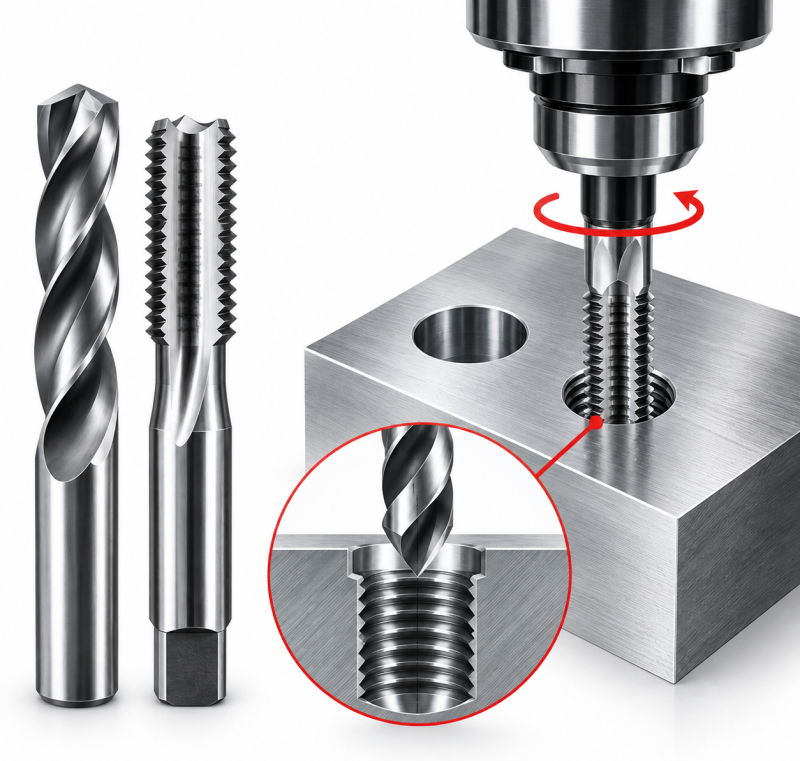
Selecting the correct drill diameter before tapping is essential for producing accurate and reliable internal threads.
For inch threads, the recommended tap drill size depends primarily on the nominal thread diameter and threads per inch (TPI). Choosing an appropriate drill size helps achieve proper thread engagement while reducing tapping torque, excessive tool wear, and the risk of tap failure.
The following information provides a practical reference for common Unified Inch Thread systems, including UNC, UNF and UNEF.
Understanding Inch Thread Designations
A typical Unified thread designation may look like:
1/4-20 UNC
This means:
- 1/4" — Nominal thread diameter
- 20 — 20 threads per inch (TPI)
- UNC — Unified National Coarse thread
For example, a 1/4-20 UNC thread commonly uses approximately a 5.1 mm tap drill. The original reference table on the site also lists 5.10 mm for this size.
Another example is:
1/4-28 UNF
Here:
- 1/4" — Nominal thread diameter
- 28 TPI — Finer thread pitch
- UNF — Unified National Fine thread
- Recommended drill size: approximately 5.5 mm
UNC, UNF and UNEF — What Is the Difference?
UNC — Unified National Coarse
UNC threads have a relatively coarse pitch. They are widely used for general-purpose fastening applications and are often preferred where fast assembly and good resistance to thread damage are important.
UNF — Unified National Fine
UNF threads use a finer pitch than UNC for the same nominal diameter. They provide more threads within the same engagement length and are commonly used where finer adjustment or specific fastening requirements are needed.
UNEF — Unified National Extra Fine
UNEF threads have an even finer pitch and are typically selected for specialized applications requiring a very fine thread.
Common Inch Tap Drill Sizes
| Thread Size | Series | Recommended Drill |
|---|---|---|
| #2-56 | UNC | 1.80 mm |
| #2-64 | UNF | 1.85 mm |
| #4-40 | UNC | 2.30 mm |
| #4-48 | UNF | 2.40 mm |
| #6-32 | UNC | 2.80 mm |
| #6-40 | UNF | 2.90 mm |
| #8-32 | UNC | 3.40 mm |
| #8-36 | UNF | 3.50 mm |
| #10-24 | UNC | 3.90 mm |
| #10-32 | UNF | 4.10 mm |
| 1/4-20 | UNC | 5.10 mm |
| 1/4-28 | UNF | 5.50 mm |
| 5/16-18 | UNC | 6.60 mm |
| 5/16-24 | UNF | 6.90 mm |
| 3/8-16 | UNC | 8.00 mm |
| 3/8-24 | UNF | 8.50 mm |
| 7/16-14 | UNC | 9.40 mm |
| 7/16-20 | UNF | 9.90 mm |
| 1/2-13 | UNC | 10.80 mm |
| 1/2-20 | UNF | 11.50 mm |
| 9/16-12 | UNC | 12.20 mm |
| 9/16-18 | UNF | 12.90 mm |
| 5/8-11 | UNC | 13.60 mm |
| 5/8-18 | UNF | 14.50 mm |
| 3/4-10 | UNC | 16.50 mm |
| 3/4-16 | UNF | 17.50 mm |
| 7/8-9 | UNC | 19.50 mm |
| 7/8-14 | UNF | 20.50 mm |
| 1-8 | UNC | 22.20 mm |
| 1-12 | UNF | 23.20 mm |
These values are based on the reference table currently published on the PREX website.
Important Considerations When Selecting a Tap Drill
A tap drill chart should be used as a practical starting reference rather than as an absolute value for every machining condition.
The optimum pre-drilled hole diameter may vary depending on the workpiece material, required thread engagement, thread tolerance, tap geometry, cutting conditions and machining method.
A hole that is too small can significantly increase tapping torque and tool load. A hole that is too large may reduce thread engagement and affect the strength of the finished thread.
For production machining, always consider the recommendations provided by the tap manufacturer.
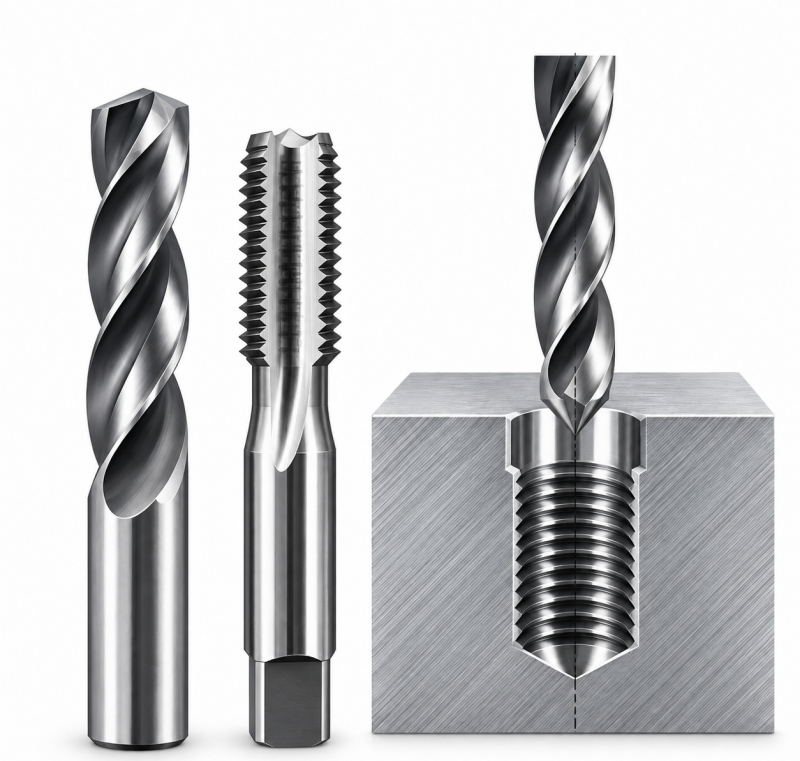
Cutting Taps vs. Forming Taps
It is especially important to distinguish between cutting taps and forming taps.
A cutting tap removes material to generate the thread profile, while a forming tap produces the thread through material deformation.
Because the processes are different, forming taps generally require a different and larger pre-drilled hole diameter than cutting taps.
Therefore, a conventional cutting-tap drill chart should not automatically be applied to forming taps.
Choosing the Right Thread Series
The correct thread series should always be determined from the component drawing or engineering specification.
Do not select UNC or UNF based only on the nominal diameter. For example:
1/4-20 UNC and 1/4-28 UNF
have the same nominal diameter but different pitches and therefore require different tap drill sizes.
Correct identification of the complete thread designation is essential before drilling and tapping.
PREX — Reliable Precision Tooling
PREX provides tooling solutions for drilling, threading, milling, turning and precision machining applications.
Our technical resources are designed to provide practical reference information that helps machinists select appropriate tooling and machining conditions for real production environments.
Premium · Performance · Precision
PREX — Reliable Precision Tooling